THE BEHAVIOR CONTROL BRIEFING
Chief Behavior Engineer with clients from Google, Amazon, Tesla and NASA reveals why 98.4% of his high‑performing, professional clients failed past attempts to break a habit, and exactly how he prepares them before a new attempt
Our clients include professionals from












Dear friends and readers,
This briefing is written for people with serious responsibility: people who run teams, companies or large budgets, and who handle pressure well at work. Yet in private, one habit keeps beating them.
98.4% of the 290+ high-performing professionals I’ve worked with over the past seven years came to us after failed attempts to break a habit.
They had made firm promises to change. Many had tried again and again. The habit kept coming back anyway.
It’s interesting when you think about it. Most people think they know what keeps their habit going. Yet when we asked our clients about it in detail, almost all of them had it wrong.
Think about that. They want to change their lives. They make a firm decision to start. They act with the best intentions...
Only to crash and burn. Then blame themselves and feel guilty, ashamed or hopeless.
WITHOUT stopping to think that maybe, just MAYBE, what they believed about their habits was wrong.
Which brings us to a pressing question...
Why DO so many attempts to break habits fail? And what steps should come before a new attempt?
By the end of this briefing, you’ll have a clear answer. One you can use in your own life.
You’ll also have the chance to privately get our internal client checklist. It’s the roadmap our one-to-one clients follow before they start working on a habit with our behavior specialists.
So keep reading. This could change the way you think about breaking a habit.
The promise holds for a few days. Then one familiar evening pulls it all back.
Before I answer that question, let me describe a pattern that comes up in our work.
Someone tells themselves this will be the last time. Then the same thing happens again.
They make the promise. They last a few days, maybe a few weeks. Then stress, boredom, tiredness or one familiar situation pulls them straight back.
Here’s what that can look like.
- There’s a habit they want to break. They’ve tried to stop more than once, and they keep going back to it.
- They can hold out for days or weeks. Then one trigger, or one hard moment, pulls them back.
- Their good stretches end the same way. One slip. Then a full return. Then the feeling that they’ve lost control again.
- Urges and excuses keep beating the decisions they made when they were calm.
- They’ve read a book about habits, marked up half the pages, and felt more ready than ever.
- They’ve picked a start date, told themselves this time is different, and gone in on willpower alone.
- They’ve put a lock on it. A blocker. A deleted app. Something thrown in the trash. A password handed to someone they trust.
- They’ve counted the days, made it to week two or week five, and watched it all end on one ordinary evening.
- The pattern starts to cost them. Their focus. Their energy. Their work. Their health. The people around them.
- And they’re tired of starting over. They want to get control back without needing a fresh burst of motivation each time.
Looking at these moments helps explain how the pattern keeps repeating. It can also clear up some common beliefs about what makes a habit stick.
And answer one question:
What’s the best way to prepare before a new attempt?
Smart, successful people fail at this too. Marcel tried ten times.
For more than seven years, my team and I have worked privately with professionals who want to break a habit they keep going back to.
Directors. Engineers. Founders.
People who run businesses, build things and manage teams for a living.
They’re good at hard things. But in private, one pattern keeps beating them.
They try to hide it. Tell themselves it’s not that big a deal. Yet they worry they’ll find a way to stop too late.
They know how much is at risk. Their relationships, their work, their health. Maybe even their money.
Let me tell you about Marcel.
Marcel is a commercial director at a consumer goods company in the Netherlands. He’d been trying to stop a habit for fifteen years. At least ten serious attempts, each with a start date and a reason behind it.
He’d done the reading too. Self-help books. The psychology of why people do what they do. Podcasts and Huberman videos on habit change. He knew the material.
YET he still couldn’t make an attempt last.
It cost him more than the habit itself. His mornings took an hour or two to get going. He took afternoon naps and told himself they were a gift. He always felt rushed, with no time left over.
Ten serious attempts by a smart, well-read adult who wanted to change and had followed the advice.
But WAIT. Before I finish Marcel’s story, there’s something else you need to understand.
I’ll come back to him, I promise.
What clients say about preparing first

In fifteen years I made at least ten serious attempts to quit. Every one of them started with me picking a day and hoping. The attempt that held started differently. I wrote my commitment down, I knew exactly what I was up against, and I had a plan for the hard hours before Day 1 arrived. If you are about to try again, prepare first.

My pattern never changed. Start motivated, white-knuckle for two weeks, fall back. Motivation always runs out. What I was missing was a plan built before I started, for the moments I knew were coming. Prepare properly once and you stop depending on how you happen to feel on the day.

I used to spend my whole day waiting to get home to the habit. What changed was having systems in place before the evening came. You map where and when it happens, you change what you can, and you walk in with a plan. The scientific approach is why I trusted it from the start.
The people who tried the hardest stayed stuck the longest
Here’s what we found in our client files, and it turned my thinking upside down.
The people who’d made the most attempts, read the most books and tried the most tools had often been stuck the longest.

Chris M, a tech lead in the United States, spent close to ten years trying programs, apps, therapy and sheer willpower. None gave him steady success.
Chris M · Tech lead · USA

Colin, a founder in the United States, spent eight years on the same fight. Timers. Habit trackers. Every video he could find.
Colin · Founder · USA
Ade, a founder in Canada, went through the same loop for years. Start motivated. Hold out for two weeks. Fall back. Repeat.
Ade · Founder · Canada
And Marcel. Ten attempts and every book on the shelf.
More effort. More tools. More years stuck.
But why does it happen?
There’s research on this too. Let me explain.
In one study of 13,417 smokers, people who’d recently tried to quit and failed were less likely to succeed the next time. Only 15.1% of them held, against 27.1% of those without a recent failed attempt.1
A failed attempt can make the next one harder to believe in.
Another study of 1,277 smokers estimated that quitting for good took around 30 attempts.2
And remember the 98.4%, the clients whose past attempts had failed. When we asked them why, almost all gave the same kinds of answers. Not enough willpower. Too much stress. A weak moment. A bad week.
So that’s what each new attempt tried to fix. They tried harder. Waited for a calmer month. Promised to be stronger this time.
But a review from 2006 found that making people want to change more had a much smaller effect on what they actually did.3
Look, most of these people already want to change.
In a 2018 study of 2,928 drinkers, wanting to drink less predicted making an attempt. It didn’t predict actually drinking less.4
And that’s how someone can put in real effort, lose another attempt, and start trusting themselves a little less. After a while, they begin to think THEY are the problem.
They aren’t the problem. They’ve been trying to fix the wrong thing.
The habit lives in places, times and moments. That is where the plan has to go.
The habit is tied to places, times and moments, so that’s what the preparation needs to cover.
The place carries the habit.
A study followed students as they moved to a new university. Old habits were more likely to stick when familiar surroundings stayed the same.5
Juan Carlos put it plainly. He used to spend his whole day waiting to get home to the habit. For him, it was tied to one place and one hour.
Juan CarlosSenior product manager · SpainStopping doesn’t erase the habit.
Learning a new response doesn’t wipe out the old one. Being back in a familiar place can bring it out again. Researchers call this “renewal.”6
That helps explain why a holiday can feel easy and the first week home doesn’t.
The trigger starts the urge.
A review of studies across drinking, smoking and other habits found that just being reminded of the habit could bring on a craving.7
Stress makes it harder to think ahead.
When someone is stressed, planning and saying no can get harder, while old, automatic responses come more easily.8
“Now I know how my brain works and what it needs.”
 BjornSenior operator · Netherlands
Now, the moment that matters most.
The twenty minutes after a slip.
There’s a name for the “I’ve already blown it” reaction: the Abstinence Violation Effect.
Someone slips and thinks, “I’m weak. I knew it. I always do this.” Their confidence drops, and ”I’ve already blown it” becomes a reason to keep going. A study of 75 adults trying to stop a substance they’d used daily for years found the same pattern.9
That’s why we plan for those first twenty minutes, before one slip turns into a lost week.
And while new habits take time to form, another study found that missing one day didn’t undo people’s progress.10
One slip doesn’t have to end the attempt.
None of this is a promise about anyone’s brain. It helps explain why a plan needs to cover the places, times and minutes when the habit happens.
Willpower, blockers, books and streaks all leave the same three moments unplanned.
Look at what most people do when they try to break a habit.
- 1
Willpower and a start date.
On a stressful evening, it can be harder to think ahead and resist an urge, even when the plan hasn’t changed.8
“I started them unprepared and tried to white-knuckle everything after that.”
 IngeSenior operator · Belgium
- 2
Blockers and restrictions.
They can help. But the urge still comes at nine o’clock, and the empty evening is still unplanned. A determined adult can usually get around a setting. When the blocker comes off, the same room and the same hour are waiting.
- 3
Books and trackers.
Books can make people want to change. But wanting alone doesn’t do as much as people expect. Look at Marcel. He knew the material and still failed ten times. Trackers count a streak. One slip can then feel like losing every day before it. That’s what the “I blew it” effect feeds on.
“I tried everything I could get my hands on: timers, habit trackers, every video I could find. None of it held, because I kept starting with nothing prepared.”
ColinFounder · USA- 4
Learning more, but still not knowing what to do.
There’s another problem that can come with all that reading. Someone starts with a book on habits, then watches a podcast on dopamine. Soon they’ve saved hours of advice about the brain and how to change.
But now there’s so much to take in that they don’t know where to start. Which advice comes first? What needs to change before Monday? What are they actually going to do when an urge turns up?
Look, the information can be useful. The missing part is a step-by-step plan that turns it into something they can follow.
Otherwise, they can explain the science and still be sitting on the same couch at nine o’clock, unsure what to do next.
- 5
Support from a partner.
The research is mixed. Support helps most when there’s trust and both people know what to expect. A partner can check in on Friday. They’re rarely there at eleven on a Tuesday night. And nobody wrote down how to handle that moment.
Each can leave the same three moments unplanned. The trigger. The urge. The twenty minutes after a slip.
“Motivation always runs out. What I was missing was a plan built before I started, for the moments I knew were coming.”
AdeFounder · CanadaThe answer is a checklist,
run before you begin your attempt.
It’s the same idea that keeps pilots and surgeons safe.
Pilots: before every take-offSurgeons: before every operationOur clients: before every new attempt
We’ve used the answer in our private work for years.
Before our one-to-one clients start working on a habit, they prepare.
They follow an internal checklist our behavior specialists use with every client. It covers the things people skip when they feel ready and want to start right away.
What sets the habit off? What needs to change in the daily routine and surroundings? What’s the plan when an urge comes? What’s the plan for the twenty minutes after a slip?
Think about it like this.
Pilots use a checklist before every take-off, no matter how much experience they have.
A 2009 study looked at what happened after hospitals introduced the World Health Organization’s surgical checklist. Deaths after surgery fell from 1.5% to 0.8%, and complications fell too.11
The checklist helped make sure the steps got done.
Even skilled people skip obvious steps. So we put those steps on a list.
After seeing the same wrong belief in 290+ client files, we decided the checklist shouldn’t stay inside our practice. It’s now available to the public for the first time.
The Neuro-Transformation System: four stages that prepare the attempt before it starts.
Our specialists use what we call the Neuro-Transformation System.
It’s based on how the brain and body work, to help people get control of their habits from the ground up.
It starts with what sets the habit off, the daily routine, the surroundings, and the minutes after a slip. There are four stages, in this order.
- 1
Locate
Find what sets off the habit before changing anything. The times. The places. The people. The feelings. Including the ones that are easy to miss. Most people know their last attempt failed. Few can say which evening, what set it off, and what time it happened.
- 2
Modify
Get the daily routine ready for the change. Someone might be ready to stop a habit but still be sleeping badly, skipping meals and carrying stress into every evening. Those things need attention too.
So we plan the first three days: when to sleep, what to eat, when to exercise and where meditation fits. Regular sleep, meals, movement and time to unwind can help with mood, energy and managing stress.12
We also make room for things the person enjoys outside the habit. The aim is to support the brain and body while they get used to a day without that usual source of stimulation.
- 3
Install
Change the surroundings before Day 1, not after the first slip. Throw out, delete, block or move what can go. Make what’s left harder to reach or use.
- 4
Hold
Decide in advance what to do when an urge comes, and in the twenty minutes after a slip. Write the plan during a calm moment.
A 2006 review found that people were more likely to reach their goals when they’d planned, “If this happens, I’ll do that.”13
And in a study of New Year’s resolutions, even the people who succeeded had slipped along the way.14
So our clients write the slip plan before they need it. Then they put their commitment in their own words and tell one person.
The Behavior Control Checklist helps you plan all four stages in one sitting of about an hour, before a new attempt begins.
Here’s what the checklist helps you do:
- Spot the triggers you need to prepare for. Find the times, places, people and feelings linked to the habit, so you know which situations need a plan.
- Make the habit harder to repeat. Know what to throw out, delete, block or move before you start. For things you can’t remove, add barriers that make acting on an urge take more effort.
- Have a response ready when an urge hits. Get a ready-written action plan to rehearse before you begin. Keep it on your phone or a printed card, ready to follow when you need it.
- Know your next step if you slip. Prepare what you’ll say and do straight afterward, before one mistake becomes a reason to give up on the attempt.
- Get your daily routine ready before you start. Plan sleep, food, exercise and meditation for your first three days. Make those choices in advance, alongside your plan for the habit.
- Keep your reasons for stopping where you’ll see them. Put your commitment in your own words and tell one person what you’ve promised. Place reminders where the habit tends to happen.
- Catch missed steps before you begin. Run through the final checks at the end. See what’s done and what still needs attention before you sign off.
...and 20 other things to help you prepare before you begin.
With the checklist done, your next attempt starts differently.
- You walk in knowing your triggers, instead of meeting them one evening by surprise.
- The habit is harder to reach than it was, because you moved, deleted or blocked what you could before Day 1.
- When the urge comes, you are not deciding anything. You wrote down what you will do, and you have rehearsed it.
- If you slip, the next twenty minutes are already decided, so one mistake does not become the end of the attempt.
- Your first three days have a plan: sleep, food, movement and a few minutes of quiet.
Preparation does not make the attempt effortless. It makes the attempt yours: decided in advance, instead of left to how you feel on the day. That is what our clients had on the attempt that held, and what their earlier attempts lacked.
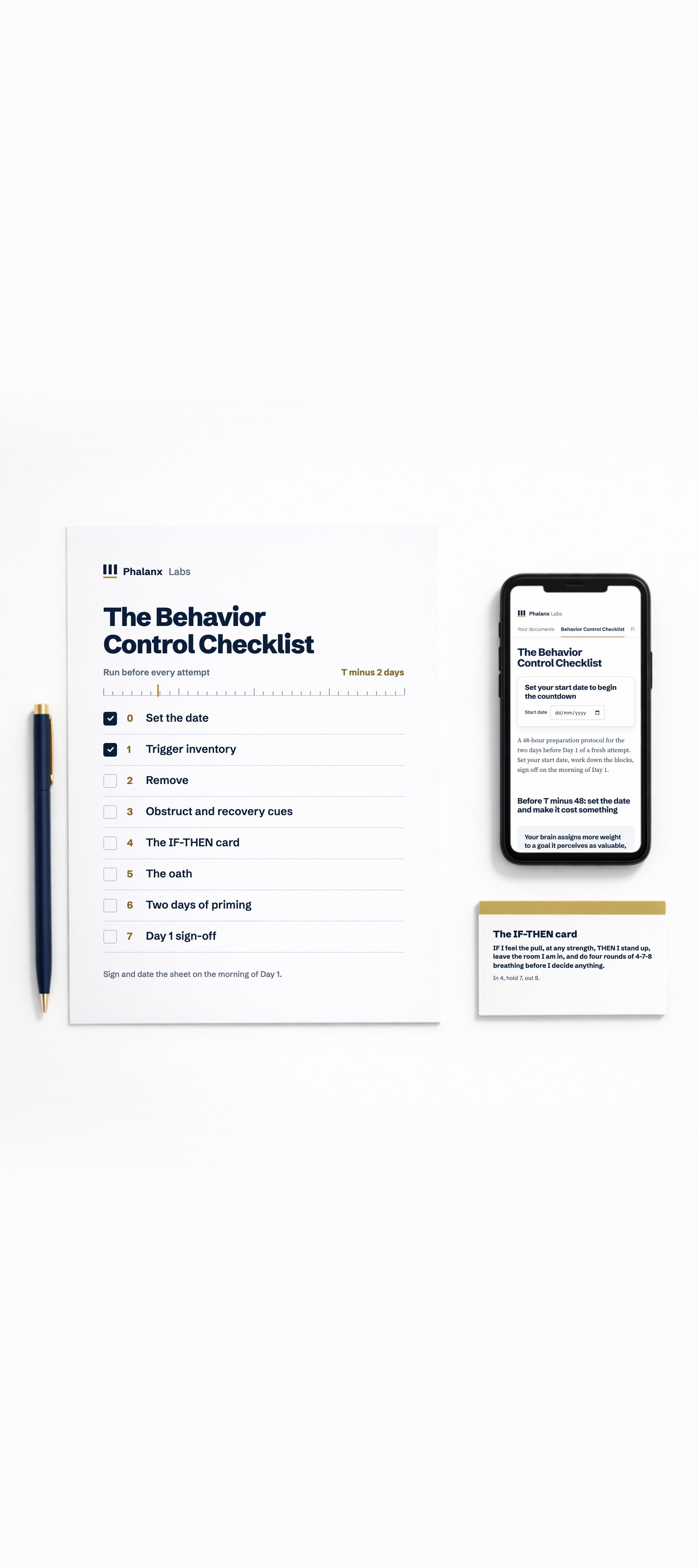 86% off for immediate action takers
The Behavior Control Checklist
Prepare your next attempt before it begins.
- Spot the triggers you need to prepare for
- Make the habit harder to repeat, before Day 1
- Have a response ready when an urge hits
- Know your next step if you slip
- Get your routine for the first three days ready
- Keep your reasons for stopping where you will see them
One sitting, about an hour. Instant access in your private portal, on your phone or printed.
$197 $27Action Takers priceThat's 86% off
One payment of $27. No subscription, nothing recurring. The checklist is yours the moment you pay.
14-day money-back guarantee. Send one email within 14 days and you get every dollar back. No questions asked.
Look at what real people who use the checklist say
Two weeks
Waqas, a tech founder in New York, built his plan with us before he started. He reported stopping within two weeks, and 32 days without it when he recorded his video. Before, in his words: “I felt like time was flying by and I was on autopilot.” After: “I am feeling a lot better.”
 WaqasTech founder · New York
Forty-seven days
Marcel, the man who had tried ten times. He reported breaking the pattern and rebuilding his focus in 47 days. More on him in a moment.
MarcelCommercial director, consumer goods company · NetherlandsThe first day felt different
Inge, a senior operator in Belgium: “This time I set myself up to succeed before the first day: I knew my triggers, I had cleared my space, and I knew what to do when a thought showed up. From the first day, it felt different.”
IngeSenior operator · BelgiumSixty days
Juan Carlos, the man who used to wait all day to get home. He reported breaking both of his patterns across 60 days. “I am much more focused. I have much more energy.”
Juan CarlosSenior product manager · SpainSeventy-one days
Bjorn started because he had lost his motivation and his joy. He reported 71 days without it, and said this attempt was easier than the ones before, because of the information and the daily training. “I feel better. I am more motivated in pursuing things that give me joy.”
BjornSenior operator · NetherlandsTwo and a half months
Ade, after years of the same two-week loop: “This is currently the best I’ve felt physically and mentally.”
AdeFounder · CanadaNow the longer follow-up.
Ten years, then this
Chris M, after close to ten years of programs, apps and white-knuckling, said this was the best he had been in those ten years. He has a stressful job and a family, and he stays consistent. “The program has helped me develop a system and consistency day-to-day.” And on what he never had before: “What I never had was a procedure for the moment it gets hard. Writing that down before you start, what you will do and where it usually goes wrong, is the step most people skip.”
Chris MTech lead · USAEight years, then this
Colin: “I can now put so much time and effort into my business.”
ColinFounder · USAFifteen years, then this
Jeroen, a tech professional and founder in the United States: “Life is so much better now.”
 JeroenTech professional and founder · USA
And then Marcel.
Fifteen years. Ten attempts. Every book.
Four months after he started, he had not gone back to the habit once. The mornings that used to take two hours now start at 5:30. The afternoon naps are gone. In his words, “now I have time left.”
“Focus on work has been through the roof.”
MarcelCommercial director, consumer goods company · NetherlandsAnd the line I think about most. It is a real commitment, he said, to changing your life. And he called it the most effective system he has ever come across.
Now, we’re not saying the checklist can break a habit completely on its own. That wouldn’t be honest or professional. That’s not what this is.
What we claim and stake our reputation on is this:
The Behavior Control Checklist provides everything needed to plan, organize and perfect a habit-change attempt.
Every attempt that starts unplanned makes the next one harder to believe in.
The clock is ticking anyway.
The more a habit is repeated in the same place at the same hour, the stronger that link can become. That’s how habits are learned. The same couch, the same time of night, starts the same urge again.
An attempt that starts without a plan for the slip can end up repeating the same “I blew it” ending. It gets easier to fall straight back into it.
Most people try again anyway.
That’s what capable people do. They keep working for what they want.
The question is whether the next attempt starts like the last one, or with a better plan and a clear idea of what to do.
Start the next attempt the same way, or start it prepared.
An attempt can start the same way as the last one. A date. Determination. Nothing written down for the evening, the urge or the slip. It might work. Sometimes it does.
Or it can start with what our private clients do before they begin: prepare for those three moments.
See what the Checklist covers. It’s our internal client checklist, available to the public for the first time. Complete it privately in about an hour, on your phone or in print. It takes you through all four stages of the Neuro-Transformation System.
Get your Checklist and be the person who prepares. Marcel prepared. Waqas prepared. Inge, Juan Carlos, Bjorn, Ade, Chris M and Colin prepared. Every one of them started the attempt that held with the hard moments already decided.
AND HERE’S THE BEST PART...
At Phalanx Labs, we’re big on taking action. It’s our number-one requirement for the people we work with.
To encourage that in you, and reward people who act on what they want, we have:
The Immediate Action Takers Offer
Inside our private work with clients, the Checklist is valued at $197.
For readers of this briefing who take action NOW, it’s ONLY $27. That’s 86% off.
It comes with a 14-day money-back guarantee. If it’s not for you, send one email within 14 days and you’ll get every dollar back. No questions asked.
86% off for immediate action takersThe Behavior Control Checklist
Prepare your next attempt before it begins.
- Spot the triggers you need to prepare for
- Make the habit harder to repeat, before Day 1
- Have a response ready when an urge hits
- Know your next step if you slip
- Get your routine for the first three days ready
- Keep your reasons for stopping where you will see them
One sitting, about an hour. Instant access in your private portal, on your phone or printed.
$197 $27Action Takers priceThat's 86% off
One payment of $27. No subscription, nothing recurring. The checklist is yours the moment you pay.
14-day money-back guarantee. Send one email within 14 days and you get every dollar back. No questions asked.
One last thing.
Marcel had read the books. He had the determination, ten separate times. Fifteen years of picking a day and hoping.
His advice, in his own words: “If you are about to try again, prepare first.”
Just get the damn checklist and make it easier on yourself.
The Behavior Control Checklist
$197 $27Action Takers priceThat's 86% off
One payment of $27. No subscription, nothing recurring. The checklist is yours the moment you pay.
14-day money-back guarantee. Send one email within 14 days and you get every dollar back. No questions asked.
Manish “Leo” Shetty
Founder and Chief Behavior Engineer
Phalanx Labs
References
- Partos et al., 2013
- Chaiton et al., 2016
- Webb & Sheeran, 2006
- de Vocht et al., 2018
- Wood et al., 2005
- Bouton, 2002
- Carter & Tiffany, 1999
- Arnsten, 2009
- Stephens et al., 1994
- Lally et al., 2010
- Haynes et al., 2009
- NIMH, “Caring for Your Mental Health”
- Gollwitzer & Sheeran, 2006
- Norcross & Vangarelli, 1988
Private educational material. Not medical or psychological care.